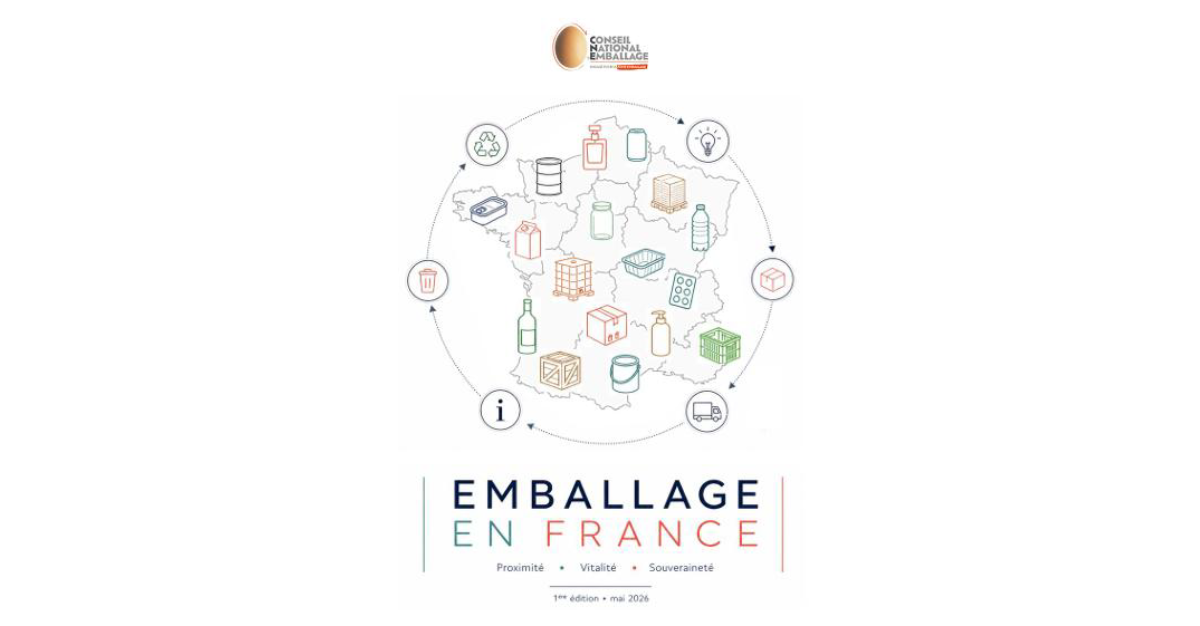
The result of several months of collective work with all CNE members, this hundred-page document offers, for the first time, a comprehensive overview of the sector, from packaging design through to end-of-life, across all materials and uses.
“Packaging is often viewed in public debate solely through the prism of its end-of-life. It remains one of the great forgotten pillars of the French economy,” notes Michel Fontaine, President of the CNE. Yet it is a vital link in our economy and in every value chain: it protects, transports, preserves, informs, makes products accessible and enables them to be placed on the market under appropriate conditions of safety, quality and performance.
The figures consolidated in the report underscore the scale of this industrial reality: more than €42 billion in turnover, 175,000 direct jobs, and around 7,500 industrial sites or organisations spread across the country. In economic and social terms, it ranks at levels comparable to those of major flagship sectors of the French economy, such as civil aeronautics or the cosmetics industry.
Each year, 13 million tonnes of packaging are placed on the market in France, nearly 70% of which are recycled, with 80% of that recycling carried out on national soil.
Beyond these data, which give a sense of the sector’s scale, the report highlights three structuring dimensions of this essential activity:
- Vitality, first of all, because packaging brings together a great diversity of professions, skills and technologies, from R&D to recycling, via materials, manufacturing, filling and packing, logistics, reuse and laboratories. It supports major societal shifts and changes in consumption patterns, from e-commerce to bulk sales, from healthcare to luxury, from short supply chains to on-the-go consumption.
- Proximity, secondly, because packaging is built on a dense network of factories, converters, technical or university centres, logistics platforms, sorting centres, recyclers, washers and expert organisations, all located close to the industrial, agricultural and logistics hubs they serve.
- Sovereignty, finally, because the robustness of the packaging value chain directly underpins that of key sectors in the French economy: agri-food, healthcare, cosmetics, wines and spirits, luxury, retail, food service and e-commerce. The report thus underlines that packaging is not a peripheral activity, but an industrial infrastructure indispensable to the functioning of the real economy.
In a context of profound transformation — decarbonisation, circular economy, reuse, recyclability, the evolution of EPR schemes and European harmonisation via the PPWR — the Conseil National de l’Emballage aims to make this publication a reference tool to inform public debate, showcase the sector’s know-how and promote the concept of Juste Emballage: packaging designed for the benefit of the product, its users and the environment.
“This work is a first milestone in securing recognition of packaging as a strategic industrial sector, essential to our economy, our regions and our sovereignty. The challenge is not only to better understand the sector, but to restore it to its rightful place in our shared industrial narrative and in public policy,” concludes Antoine Salles, Director General of the CNE.